Why Choose an Industrial Servo Motor for Your Project?
In today’s industrial landscape, the choice of drive systems is crucial. Industrial Servo Motors stand out for precision and efficiency. According to a report by MarketsandMarkets, the industrial automation market is expected to reach $296.7 billion by 2026. A significant part of this growth stems from the adoption of servo motors.
These motors are designed for high performance and reliability. They provide better control over speed and position, ensuring optimal operation. Choosing an Industrial Servo Motor can enhance the quality and consistency of product manufacturing. However, some manufacturers remain hesitant due to perceived costs. Data shows that initial investments in servo motors yield long-term savings through reduced energy consumption and maintenance requirements.
Nevertheless, selecting the right servo motor can be challenging. Some projects may not require the precision that these motors offer. Balancing cost and performance is a complex task. Understanding specific project needs is essential before making a decision. Ultimately, an informed choice can lead to improved operational efficiency and product quality.

Benefits of Using Industrial Servo Motors in Automation Projects
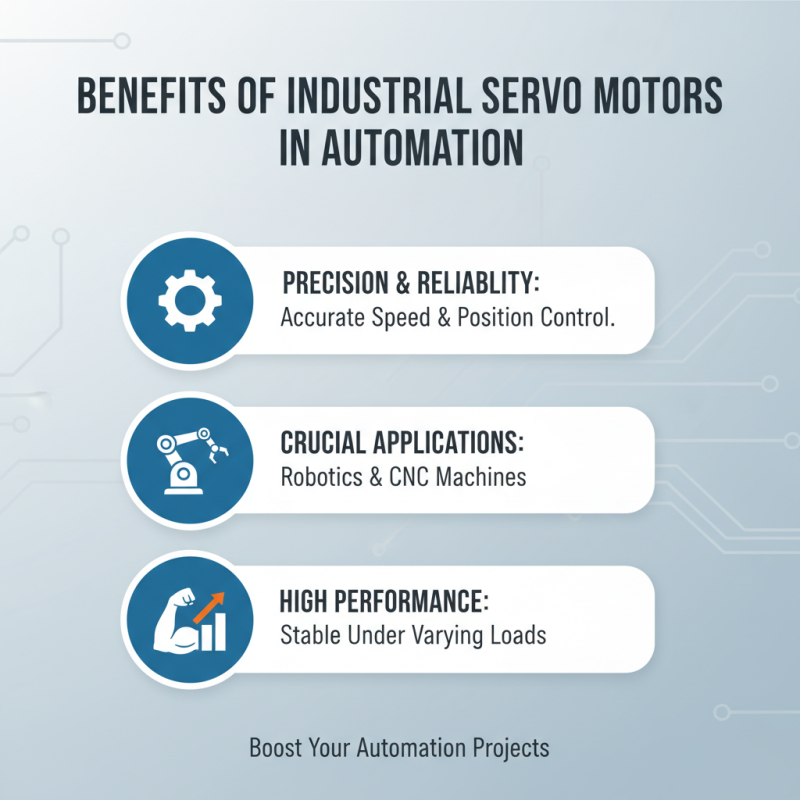
In automation projects, industrial servo motors stand out for their precision and reliability. They provide accurate control of speed and position. This is crucial in many applications, such as robotics and CNC machines. Their ability to maintain performance under varying loads makes them highly effective.
The quick response time of servo motors enhances overall system efficiency. They minimize delays in operations and improve productivity. Yet, integrating these motors into existing systems can be challenging. Careful calibration is necessary, and sometimes it requires additional components. This adds complexity to the system, which might not always be ideal.
Energy efficiency is another significant benefit. Servo motors consume power only when needed, reducing overall energy costs. However, achieving optimal energy savings requires thoughtful design and programming. Many users may overlook this aspect, leading to less efficient operations. Balancing these factors can be tricky, yet the advantages are clear and compelling.
Key Features of Industrial Servo Motors for Enhanced Performance
Industrial servo motors offer several key features that significantly enhance performance in various applications. One of their standout characteristics is precision control. These motors provide accurate positioning and speed control over a wide range of movements, making them ideal for tasks that require high repeatability. The integration of feedback systems allows for real-time adjustments, ensuring optimal functionality during operation.
Another essential feature is their robustness and reliability. Industrial servo motors are designed to withstand harsh environments and heavy loads. They often come with durable casings and advanced cooling systems. However, selecting the right specifications can sometimes be confusing. Users may overlook the details that could impact performance, such as torque ratings and response times. This can lead to suboptimal performance.
Energy efficiency is another notable aspect. Modern servo motors are designed to use less power while delivering high performance. Operating in energy-efficient modes not only reduces costs but can also contribute to sustainability efforts. Yet, achieving this efficiency relies heavily on proper tuning and setup, which can be complex. Some users may need to revisit their initial configurations to maximize potential. Taking the time to refine these settings can make a significant difference in overall project success.
Comparison of Servo Motors with Other Motor Types
When comparing servo motors with other motor types, performance and precision stand out. For example, servo motors provide high torque at varying speeds, making them ideal for applications requiring precise control. According to a report by the International Energy Agency, industrial servo motors demonstrate efficiency levels up to 90%. This is significantly higher than typical AC induction motors, which often operate around 70-80% efficiency under similar conditions.
In applications demanding accuracy, such as robotics or CNC machines, servos shine. They can achieve precise positioning with feedback control. This feature contrasts sharply with less sophisticated motors, which may overshoot or lag, impacting overall performance. Industry analysis shows that linear position accuracy of servo systems can reach +0.01 mm, while stepper motors often struggle to maintain that precision over time.
However, servo motors come with challenges. Their complexity and cost can deter some projects. The initial investment may be higher. Maintenance requires specialized knowledge and tools. Troubleshooting can also be more difficult than with simpler motor types. Balancing these factors is crucial when deciding on the best motor for any specific application.
Why Choose an Industrial Servo Motor for Your Project?
Common Applications of Industrial Servo Motors in Various Industries
Industrial servo motors play a crucial role in various sectors. They offer precise control, reliability, and efficiency for demanding tasks. These motors find their place in applications like robotics, CNC machines, and packaging equipment. The ability to control speed and position makes them ideal for automation needs.
In the automotive industry, servo motors drive robotic arms for assembly. They help in tasks like welding and painting, ensuring uniform quality. In manufacturing, these motors enhance the precision of CNC machines, providing accurate cuts and movements. In the food industry, they ensure packaging machines work seamlessly, improving overall productivity.
Tip: Consider the load requirements. Not all servo motors handle the same weight or force. Testing various options could lead to better efficiency.
The use of servo motors in medical devices is significant too. They power essential equipment like surgical robots and diagnostic machines. However, integration can be challenging. Sometimes, conventional systems do not align well with modern motors. A thorough assessment of compatibility is vital.
Tip: Always check for feedback systems. These can improve the motor's performance and provide real-time data. Understanding this can save you time and resources in the long run.
In conclusion, the diverse applications of industrial servo motors showcase their importance. Whether in robotics, automotive, or medical devices, these motors have revolutionized many industries. Their precision and reliability continue to drive innovation.
Factors to Consider When Selecting an Industrial Servo Motor for Your Needs
When choosing an industrial servo motor, there are key factors to consider. First, assess the torque requirements for your application. Torque determines how much load the motor can handle. According to industry reports, nearly 45% of servo failures stem from incorrect torque calculations.
Speed is another critical factor. Different applications require varying speeds. For example, packaging machines often need quick response times. Studies show that a motor's speed can affect production efficiency by up to 30%.
**Tip:** Analyze your application’s acceleration and deceleration needs. Selecting a motor that can adapt to these parameters is crucial.
Another important aspect is size. Space constraints in machinery can limit available options. Ensure that the motor you select fits well within your equipment dimensions. However, compact motors may lead to overheating risks, which is worth considering.
**Tip:** Always leave some room for airflow around the motor. This can extend its lifespan and efficiency.
Ultimately, thoughtful analysis of these factors will lead to a better-performing system. Don’t overlook the importance of aligning motor specifications with your project demands.
Why Choose an Industrial Servo Motor for Your Project? - Factors to Consider When Selecting an Industrial Servo Motor for Your Needs
| Factor |
Description |
Importance Level |
| Torque Rating |
Indicates the maximum rotational force the motor can provide. |
High |
| Speed Range |
Defines how fast the motor can operate effectively. |
High |
| Feedback Method |
Specifies how position and speed are monitored (encoder type). |
Medium |
| Power Supply |
Voltage and current requirements for optimal operation. |
High |
| Size and Weight |
Physical dimensions and weight, affecting installation and application. |
Medium |
| Environmental Considerations |
Operating conditions such as temperature, humidity, and dust. |
High |
| Cost |
Initial investment required for the motor and related systems. |
Medium |
| Support and Documentation |
Availability of manuals, installation guides, and customer support. |
Low |


 Baijia Hao